Penis enlargement program is very helpful to men. It can help them achieve the additional inches and self-confidence they need only if they follow the instructions. Performing the penis exercises and wearing the traction device can be done easily at home where nobody can see you especially if you’re alone. You have to be careful with this if you’re married or, living with your friends or relatives.
Married men should not worry at all because they can consider asking their wives for help. Why not? It may be an unbelievable idea but there’s no harm in trying. Talk to your wife about it, that you want to do it with her. Tell her how important it is to you, that you’re doing it for her too and she’ll be helping you with all her heart.
Women are caring and nurturing by nature and so you have a good chance that she would consent to help you with this, especially if you make it sound like a game or a secret that only you two share. They are also going to be intrigued by the idea of penis enlargement exercises and will probably want to see what these exercises are all about and maybe a live demonstration. From a live demonstration, it’s really a small step to getting her to see what a hands-on session feels like. People are curious by nature and always ready to try new things.
Remember: don’t be too aggressive. You don’t need to force your partner to like penis enlargement. We all know that not all women are open-minded with this idea. Don’t oblige her to help you neither blackmail her because this can only be the reason why she’ll leave you in the end. What you should do is persuade her about penis enlargement, that it is something both of you should be involved of. In time, she’ll realize how it can be of big help to your relationship that she will understand and be willing to give you the support you need.
Tuesday, July 17, 2007
Penis Enlargement: Do It with Your Partner


More Choices for Women in Diamond Buying
There was a time when buying a diamond for a woman was almost as standard as buying a loaf of bread. When the need arose, a man would go to his local jewelry store and pick out a modest solitaire setting as a token of his love. It probably looked similar to what all her friends had and she was just happy to know that she was becoming someone’s wife.
A lot has changed since our mothers and our mothers’ mothers said their vows. Today it is the norm for women to have an influence in buying their diamond. Some women even pick out and help pay for their ring.
With this comes choice, and in 2007 there are more choices than ever when it comes to selecting a diamond. The result is bigger stones, nontraditional settings, and designer collections. There is even an influx of right-hand rings, for women who want to wear a diamond with or without a man.
Not long ago a three-carat diamond was considered a sizable rock, now women are looking for nine and ten carats without batting an eye. One reason for this is because couples are getting married older so they typically have more money to spend.
Fancy shapes and colored stones are also becoming more popular for engagement settings. While the round brilliant shape is still the most popular, princess and oval cuts follow closely behind. Modified square emeralds are also trendy because of their similarity to the Royal Asscher cut, a classic cut made popular again through Sex and the City and recent celebrity engagements.
Julia Stewart, a student at Frederick Community College, still has some time before she gets engaged, but she already has the ring of her dreams picked out. I want a Danhov piece with micropavé diamonds outlining the setting. This way the round brilliant center stone I want will appear even bigger and more sparkly, Stewart says with a twinkle in her eye. Today many women share this sentiment of wearing a designer ring.
Instead of blending in with traditional settings and stones, women want to show off their unique taste. With more choices and more buying power, women in 2007 are doing just that.
3 Tips for Selecting the Right Color for Your Outfit
As if figuring out the cut and style of your clothes wasn't hard enough, obviously you have to also decide on what color to wear. You can decide to make it easy and always wear all black, but that's boring and not always appropriate. The whole situation can leave a shopper wondering and worrying about the season's color trends, what matches their complexion and the appropriate color choice for the occasion. Some hints and tips can help a lot if you are one of the many color challenged people out there.
Let's move right along to color coordinating tip number one. Before you even consider the colors on the clothing racks, you need to determine what type of occasions you are going to use the outfit for. In recent history many of the classic color rules have been deemed outdated. This turn of events helps somewhat, but you still want to be appropriate. Take a wedding for example. It is still considered bad form to wear white or the wedding colors. Of course if you don't know what colors the bride is having the bridesmaids wear, it's like shooting in the dark. A good rule of thumb for this type of occasion is to pick a festive color for your outfit that you feel good about. The season the wedding is in will have bearing on your color choices as well.
Color tip number two is something everyone has considered at one time or another. How do you determine what colors look good with your complexion? You read in magazines and see warm, cool, and neutral colors referred to all the time on TV. Each person is different and the classic complexion colors can be mixed in any combination on anyone's face. The key here is to determine your base complexion color. Your eye is better than any complexion chart. If you find a shirt or dress you like and like the color, hold it up in the most natural light possible to your face. From there, make a judgment call; does it make your skin look washed out? Don't be afraid to ask the opinions of salespeople, your shopping buddy, or even your significant other. Even if they don't know why the color is right or wrong, they should still be able to tell if it looks good on you.
Many people believe wearing an all black outfit is more slimming than color coordinating various colors. So color outfit tip number three is about wearing a solid outfit in any color. Let's look at the myth of all black. Yes, wearing an all black ensemble can be slimming, but so is wearing a solid color outfit in any shade. Even pastels can be used to create a uniform slimming appearance. The key to using this technique is to make sure your accessories bring attention where you want it. Consider a bright scarf or metallic necklace to break up the monotony of the one color. This is also an excellent opportunity to be outrageous with your handbag or earrings. Using accessories wisely is the name of the game in regards to successfully pulling off a monochromatic outfit.
There are countless color fashion rules. The most important things to remember are to pick appropriate colors for the occasion, decide on a color scheme that accents your style and skin color, and wear colors that make you feel good. Beyond all of that, your choice of color outfits is entirely up to you. Don't go along with color trends that don't match your complexion or you don't like simply to fit in with what some magazine tells you is the "in" color for the season. Express your personal style and individuality with the type and color clothing you wear. After all, that is why there are so many unique options in apparel out there.
6 Easy Steps to Finding the Perfect Network Group
6 easy steps to finding the perfect networking group
It has been said that 80% of business today comes from referrals. People want to do business with people they know, like, trust and respect. One of the best places to develop strong referral relationships is at a networking group. These groups typically meet once a week, with the same core group of people in attendance. Here are the top 6 ways of selecting a group that is right for you:
1.Talk to the members
All networking groups allow you to visit as a guest before asking you to decide joining them. Spend time talking to as many of the existing members as possible to learn about how it’s worked for them.
You might want to know more about the turnover rate of members.
What results are being produced? What do they like/dislike about the group? What have they learned since joining? How, besides receiving leads, have they benefited? Do they feel their best interests are being looked after?
2. Consider the fees
How do the fees compare with traditional methods of generating leads? Ask yourself if it is cost effective - not is it expensive? Assess what each lead could be worth to you and how that equates to the fees involved. Everyone seems to know the cost of things and not their value.
3. Consider the group's structure
Some people like structure, some don't. Decide what works best for you!
The structured groups do tend to produce the most results as they keep you focused on producing qualified leads for one another. Consider if the structure suits your personality. Will you be able to adhere to the rules and regulations?
4. What opportunities are there to take on a leadership role
This is really important as it gives you the chance to show off how you do things. It will raise your status and credibility in the group and show you to be a leader. You will also create a greater awareness of your offering, which, in turn, will bring you more leads.
5. Be honest about your level of commitment
Will you be able to attend the meetings regularly? Building business relationships takes effort and you’ll need to be committed to growing them. If time is an issue, join a group that is less structured and works more on a drop-in basis. Go as often as you can to create mutual business relationships.
If you resent the time it takes to go to these events you will not be going with the right attitude for yourself and your fellow members.
6. Make sure there is a code of ethics
Remember, you're making referrals. Your name is on the line. You need to know that the other people in the group are reputable, too.
Find out who is running the group. What is their reputation? Do they provide training on networking strategies and techniques? What other kinds of support are provided?
Be sure that the values of the group are a good match for you.
Teleconferencing: Inexpensive Audio Conference Call Service, Leading to A big time Economical Boom
Be it a small business or an enterprise level, saving is the most important issue. You need to contact or communicate with clients and the in-house staff. Thus, every business requires regular teleconference to stay in touch with not only clients but also their legal advisors, technical support, and marketing and sales team. This clearly shows that your phone bills would rise with rising communication and so your blood pressures as you have a look at that huge phone bill. This stressful scenario and today’s technology introduces teleconferencing that works as the finest option to rule out that ever-rising phone bill issue as your business flourishes.
Teleconferencing is actually a meeting involving many people from either same or different places across the globe. In past few years, teleconferencing has answered the inevitable communication needs of almost all businesses. Rising need and ease of use of teleconferencing has given rise to more and more teleconference companies and service providers who are offering their top quality and low-cost conference call services.
Including video, web and audio conferencing, conference call services allows you to communicate with both, your in-house team and far flung clients in the most effective, in fact, cost-effective manner. Moreover, teleconferencing offers you to remain in touch with everybody you want using dynamic lines of communication costing just few bucks unlike those huge phone bills.
Nowadays, teleconferencing is one of the most competitive markets as growing number of companies have started trying and utilizing the video and audio conference call services. This rising competition has resulted into dropping prices for the conferencing services offered by teleconferencing service providers. Most of the providers offer inexpensive conference call at unbelievably flat rates cutting your phone bills by over 40%. When it comes to the cost of bringing people in, web conference calls seem to be really inexpensive.
You will be pleased to know that more than 50 people can be accommodated and discuss the things at the same time on a same line via a conference call. A reliable audio conference call service allows people to plan their schedules and conferences, discuss various company issues and come up with brilliant winning ideas without visiting places or setting one venue.
Well, the advantages of teleconferencing are still on the way and don’t end here only. These conference calls are free of any time restriction and can be made regardless of time. There are various economical yet feature rich conference call packages offered by teleconference companies. These packages are flexible enough and can be customized meeting the users’ exact needs. To avoid any technical problem if arises, customer support is available at clients’ disposal anytime.
Apart from attractive prices, there are many appealing promos and discounts that make an audio conference call service worth giving a try. By now, it must be very clear that teleconferencing can stretch the value of your business into dollars.
Last but not the least among advantages of teleconferencing is the easy downloading of big n bulky files within minutes that you otherwise used to send through courier, another key aspect of company budget. Big thanks to teleconferencing that has brought today’s businesses a new meaning with an economical twist through such inexpensive call services.
Tips For Buying Cell Phone
After reading several opinions I became aware of how confusing and time spending it can be the simple task of going to the mall searching for a new cell phone (telefone celular). There are so many options, brands, models, deals and services available that one can get very confused when it is time to make a choice of which is the best deal to choose from all the options available. Thinking about this problem, I decided to point out a few suggestions and I hope it can be of good use for those who want to save some time, money and find better deals.
Before deciding to buy a cell phone (telefone celular) handset it is wise to really know what your needs are and which type of service will serve you better. If you are an occasional user of a mobile phone, perhaps you may want to consider a service that offers the prepaid charges rather that the service that charges you by the month.
The prepaid choice seems to be very attractive for those on a low budget and also simply because it will give you total control of how much money you want to spend, let`s say in one month or during a certain time. This service is also known as pay as you go. It is by far the most popular plan available today. Keep in mind that with this plan, there is no contract to sign and therefore no penalties involved in case one decides to quit or use another service.
Don`t be an impulsive buyer, before you make any decisions on purchasing a brand or model, I strongly suggest you to look for the online deals available. I personally have found very attractive deals on the internet and the online deals have become very popular with most users. Carefully check the options, prices, features on each model and compare the final costs with the models available at your local shop. Keep in mind that the overhead expenses the traditional shops have are the main reason for the same product to cost much more than the similar product obtained from an online source. Always prefer payments with credit cards, which will offer more security for the online transaction.
Since there are several models and brands of cell phones (telefone celular) available in the market today, you may want to choose what seems to be most appealing to you regardless of its size, shape or design. You are the one who will be using it and you should be pleased with your choice.
Many new features and gadgets have been added to the new generation of cell phones (telefone celular). Most major brands have a variety of models that will certainly satisfy from the simpler to the most sophisticated user. The latest mobile phones have capabilities which include video calling, video recording, digital camera, mp3 player, GPS tracking system and other features. So if you don`t need any of these features, you may just want to stick to the basic and no frills type of handset which is much less expensive to purchase and much simpler to use.
This article is under GNU FDL license and can be distributed without any previous authorization from the author. However the author´s name and all the URL´s (links) mentioned in the article and biography must be kept.
Article Source: http://activeauthors.com
Cell Phone Purchase Guide
To own a cell or mobile phone (telefone celular) used to be a dream of most people not long ago. But as technology evolved and with the introduction of new players in the market, they became available with an affordable price range.
These days, cell phones (telefone celular) can be found from different manufacturers and even the cheapest of them boast features such as FM radio, camera and MMS capabilities. Amid the wide-range of models available to the customers in the market, it is often difficult to make a perfect choice.
Although design and looks of mobile phones (telefone celular) are factors that may influence one to make a purchase, the following are some important considerations that should be taken into account while buying a new device.
1 - Contrary to what most people think, it is the calling plan that is more important than the cell phone itself (telefone celular). You may get a host of attractive features with the device but unless its calling plan is suitable for you, it is not worth buying it.
One important thing about a calling plan is the regional or nationwide service coverage. Imagine if you are going to extensively use your cell phone (telefone celular) only within a particular region, then there is no point in getting a device having nationwide coverage. This can save you a substantial amount of money.
Also, choose the right cell phone plan for your calling habits. If you are the one who literally spend a fortune on their phone bills, then go for the services that offer saving schemes. Otherwise, you can opt for services that help you control your expenses on cell phones (telefone celular).
2 - Think if you really need a camera phone. How often will you be using it in your day to day life ? Besides, most online service plan providers offer a free handset with their service plan. Some even offer a cash-back on the cell phone (telefone celular) purchase. So, explore your options before buying a device.
3 - Don`t go by the look of the cell phones (telefone celular). Eventually, it becomes outdated over the times. A bulky hand-set is difficult to carry around. So pick one that fits your size.
4 - Pick a wireless carrier first then select the phone you want. Inquire your friends, relatives, and acquaintances if they are satisfied with the phone service they are using. Since, you will be using it in the same neighborhood they are the ones who can offer you the best advice on this.
5 - Online purchase is always a good idea as you can get the accurate descriptions in writing before you buy. Shopping online allows you to know the plain truth about each phone (telefone celular) and service. On the contrary, staffs of cell phone kiosks are paid on a commission basis and they always try to con the buyers into buying their phones at a higher rate. So you can never be sure about these buys.
This article is under GNU FDL license and can be distributed without any previous authorization from the author. However the author's name and all the URLs (links) mentioned in the article and biography must be kept.
Article Source: http://activeauthors.com
Four Wheel Drive Systems
There are a few types of four-wheel-drive systems available in the market. They are automatic four-wheel drive system, part-time four-wheel drive system, full time four-wheel drive system and all wheel-drive system.
In automatic four-wheel drive system, when in normal mode, the vehicle travels in two-wheel drive and typically with rear wheels being the driven wheels. A driver can set an "auto 4WD' function with a touch of a button on the dashboard. The vehicle will then decide when to activate and de-activate four-wheel drive.
When the vehicle engages four-wheel drive, it manages to transmit the power; as necessary, to both front and rear wheels or to wheels with the most traction. The driver can also switch to low gear for improve torque in off-road terrain.
An automatic four-wheel drive system requires a centre differential or some kind of viscous coupling or multi-plate clutch, a transfer case, two drives hafts, two axle differentials and two powered axles. An example of an automatic four-wheel drive vehicle is the Jeep Grand Cherokee.
Meanwhile, the most basic four-wheel drive system is the part-time four-wheel drive system that is available in many four-wheel drive vehicles. In normal mode, the vehicle travels in two wheel-drive, typically with rear wheels receiving power and pushing along the front. The driver is responsible for engaging and disengaging the four-wheel drive. By activating the four-wheel drive, the power is sent to the front wheels and continues to power the rear as well.
When on off-road terrain, the driver can engage an extra-low gear for improved torque while in four-wheel drive mode. A part-time four-wheel drive system requires a transfer case, two drives hafts, two axle differentials and two powered axle and does not include a centre differential. An example of this vehicle is the Ford Ranger.
A full-time or permanent four wheel drive system has no two- wheel-drive mode. They always operate with power going to all four wheels, so the drive can benefit all the time from four-wheel traction. There is also no way to turn off the four-wheel drive. A full- time four-wheel drive requires a centre differential, transfer case, two driveshafts, two axle differentials and two powered axles. In rough off-road terrain, the drive can engage low range for improved torque. An example of a full-time four-wheel drive vehicle is the Perodua Kembara.
Meanwhile, an all-wheel drive system is used mostly in cars. An example of an all-wheel drive car is Subaru Impreza.
Spotlight On Night Driving
Driving at night presents a whole new set of challenges, even for the more experienced drivers among us. The reason us, with visibility reduced by the darkness, hazards that may be glaringly obvious in daylight might be harder to see. However, there are steps you can take to ensure a safer drive through the night.
Tip #1. How well can you see? Do you need glasses or contact lenses? Consult with your optometrist. Even those who do not need glasses for their day-to-day tasks, might be required to wear prescription glasses while driving at night.
Tip #2. Go slow when you are leaving a brightly lit building. This will give you eyes time to adjust to the darkness.
Tip #3. A windscreen that is clean and clear. Make sure that your wipers are working efficiently and that the water level in the screen wash bottle has been checked and refilled. Check to see if your vehicle’s lights are clean, working, and set correctly.
Tip #4. Use your low beams in town. On rural lanes, use the full beam only when there is no approaching traffic. Judging speed and distance of other road users correctly is a lot harder in the dark so make sure you keep a safe distance.
Tip #5. Use the light of oncoming vehicles and the vehicles ahead of you to gain valuable clues on the layout of the road. Think about what might be lying ahead and use all the clues you can to anticipate what might be coming up. Clues available include road signs, white lines, and other markings.
Tip #6. Don’t retaliate if you are dazzled by oncoming traffic. Two dazzled by oncoming traffic. Two dazzled drivers are twice as dangerous as one. Move your eyes away from the dazzle and reduce your speed. Be prepared to stop if necessary.
Tip #7. If you are feeling tired, stop. The undeniable fact is, night driving is very tiring because you have to concentrate harder. Make sure there is good ventilation in your car, get plenty of rest before embarking on your journey, and schedule frequent rest stops into your journey to prevent driver fatigue.
Tip #8. When in doubt, don’t overtake. Drivers re advised to be extra careful about overtaking at night. Hazards may be out of the range of your headlights and pose a significant threat if you can’t react fast enough.
Monday, July 16, 2007
Are you a dangerous driver?
We see them everywhere: swerving in and out of lanes, ignoring safety rules, and engaging in other rude (and dangerous) behavior. Or are you one of them? Here are 10 ways to tell:
- When you reach a stop sign and no one is coming from another direction, do you roll through instead of stopping? An overwhelming majority of bad drivers feel that they should be able to speed, go through stop signs, and break other driving rules and regulations as long as no one gets hurt.
- Do you take food and drinks on the road with you, driving with one hand while using the other to eat? A driver can be easily distracted when trying to eat or drink while driving. Worse happens when spillage occurs and these drivers try to clean up after themselves while driving.
- Do you talk on the mobile phone while driving instead of pulling off and stopping to talk? Everyone knows that the act of holding the mobile phone with one hand while holding the steering wheel with the other significantly reduces your control over the vehicle. More than that, research has shown that, the telephone conversation itself is a big distraction that prevents you from focusing on your driving task.
- Do you hate driving behind SUVs or other large vehicles that obstruct your view? Bad and impatient drivers become easily frustrated in such situations and often resort to reckless driving behavior when trying to overtake these vehicles.
- If you are looking for parking space in a crowded area, do you become so focused on your search that you lose sight of the cars and pedestrians around you? Parking lot mishaps occurs when drivers single-mindedly search for a parking space to a point where they fail to see other pedestrians or vehicles.
- Does listening to music while driving leave you oblivious to all but the music? Most of us are familiar with the feeling of being caught up in a catchy, finger-snapping, head-bopping, and foot-tapping tune. The question is, while you relish and enjoy the music blasting from your speakers, how much of your attention is focused on where is should be - the road? Many drivers also report that listening to loud music causes them to be more aggressive while driving.
- Does your driving change when you go into areas with higher police presence? Bad drivers, consciously or unconsciously driver more carefully when they know police are in the vicinity.
- Does your work hard, play hard lifestyle leave you sleepy behind the wheel? Leading a busy lifestyle can cause sleep-deprivation, which leads to micro-sleeps, a condition where your tired mind switches off for a few seconds. Those few crucial seconds could cause a major catastrophe if it happens while you are behind the wheel.
- Do you find yourself in confrontations on the road, either through verbal arguments or hand gestures, because of either your own driving habits or the habits of others?
- When driving with passengers, do you turn around to talk, taking your eyes and mind off the road? This scenario can easily occur especially when driving with small children or pets in the car. The driver may feel the need to constantly monitor their behavior and this causes them to divert their attention from the road.
Gearing for a smooth drive
drive. However; the concept of the gear system remains the same - to move the vehicle.
The gear system also works to change the speed of the vehicle in line with the rotation of the engine, and thus allowing the engine to gain the required momentum to move the car.
Regardless of the type of gear system, the basic components remain the same. A series of wheels with jagged 'teeth' form the
basic physical make-up of a gear system. These serve to drive the vehicle at a pre-determined speed. The gears are connected into the gear box using either a system of rods or cables with a combination of several rods. If one of these components is worn out or dam-aged, the driver will face difficulties in changing gear. In addition, the clutch plate must be in good condition because a worn out plate will also cause difficulties in getting into or changing the gears.
When metal works against metal, obviously, a lot of friction and heat will be generated. This is the reason why the gear components require the use of lubricants to reduce the friction and heat. Therefore, there must always be an adequate level of lubricants in the gear box.
Unlike engine lubricants, gear fluids do not become contaminated very quickly. However, prolonged use will cause the lubricants to lose their effectiveness. A lack of gear fluids will cause the gears to heat up and hasten the rate of wear and tear on the gear component. As a rule of thumb, gear fluids should be changed once every 6 months. However, cars with automatic transmissions will need a change of gear fluids every 40,000 km.
For some car owners, difficulty in changing gear or unusual sounds will prompt a quick visit into the workshop for major repairs. Sadly, not all mechanics are honest and ethical enough to tell vehicle owners that the problem could be a minor one and easily fixed by changing the gear fluid. Instead, unscrupulous mechanics out to make a quick buck will simply inform the owner that there is a problem with the gear box. The result is an expensive repair cost and the gear box is changed unnecessarily.
This is the reason why the Ministry of Domestic Trade and Consumer Affairs has directed all workshops to display their list of prices for parts and services. Motorists are also advised to exercise their right as consumers to see the parts that have been changed. This will help prevent the many cases of fraud that are reported each year.
Your driving style will also contribute much towards lengthening the life-span of your gears. While changing gears, make sure that the clutch is fully depressed to release the gear from the engine. At the same time, keep that foot off the clutch pedal while driving as this will cause unnecessary wear and tear on the clutch plate.
Driving Stress, Fatigue, and Nightblindedness
ROAD RANGE
We've all experienced driving stress at one point or another. A wide variety of external and internal stress factors can all contribute towards drivers experiencing frustration that can sometimes escalate into road rage. The cause of these stresses can be found within 4 levels of stress:
- Environmental Stress
a } Too much traffic
b } Inadequate lanes and highways
c } Too many accidents
d } Traffic jams
e } Poisonous toxins emitted by cars (e.g. carbon monoxide and lead )
- Nutritional Stress
a } Improper or inadequate nutrients which affect proper working of the mind and body
b } Poor diet which may cause nutrient deficiency
c } Too much sugar, artificial colourings, preservatives, alcohol, caffeine, MSG that may cause body imbalance and irritability. - Physical Stress
a } Illness
b } Backaches
c } Headaches
d } Side effects of prescription, over the counter and recreational drugs that may have side effects of drowsiness, which reduces alertness. - Emotional Stress
a } Negative emotions (e.g. frustration, anger)
b } Watching and absorbing bad driving behaviour from parents, movies and commercials
c } Increased stress in daily life. With too much stress, people feel they are losing control. The car is a powerful yet obedient tool, associated with a driver's emotional ego, and sometimes status. The car gives the driver a direct way to control their environment so that they feel they are gaining some control over their lives.
While these are generic factors that could lead to stress in every driver, there are particular factors that could lead to road rage. These factors occur when another driver:
. Swears or uses name calling
. Comes to a rolling stop
. Speeds
. Doesn't signal when changing lanes
. Makes an illegal turn
. Follows too closely (tailing)
. jumps a red light
. Fails to yield
Positive ways to handle road rage include:
1 . Use positive thought and action.
2 . Remember that people make mistakes so be prepared to give them some allowance, just as you would hope that they would be equally tolerant when you make a mistake.
3 . Practice safe driving.
4 . Acquire a supportive driving philosophy.
5 . Don't challenge aggressive drivers.
6 . Avoid aggressive drivers and report them to your traffic authorities.
7 . Be physically fit and able to drive.
8 . Reduce the stress in your daily life with exercise, meditation, deep breathing, or hobbies.
9 . Eat properly and get enough rest.
10. Take supportive vitamins, minerals, and nutrients
Road Vision
When driving, eyestrain, eye fatigue and night-blindness can produce confusion, hesitation and decreased alertness when driving. Some possible causes of eyestrain, eye fatigue and night-blindness can be contributed to:
. Aging
. Using eyes intently for hours, without rest, in an enclosed space
. Poor diet
. Improper nutrients
. Fatigue
. Incorrect vision correction (e.g. wearing improper lenses)
Some of the symptoms of eyestrain, eye fatigue and poor vision
. Inability to focus well
. Redness
. Tearing
. Itchiness
. Swelling
. Burning
. Blurred vision
. Sensitivity to glare
. Headaches
. Decreased concentration
. Difficulty adjusting to light
. Worsening nearsightedness
. Combination of nicotine, sugar, and caffeine may temporarily affect vision
Positive ways to handle eyestrain, eye fatigue and poor night vision are:
1 . Take proper eye supporting nutrients (bilberry, zinc, lutein, lyclopean, Vitamin A)
2 . Take a 1O-minute rest. Lie down, close your eyes and place a cold compress on your eyes.
3 . Take frequent breaks.
4 . Pullover for a moment and focus on something in the distance.
5 . Try to control glare with anti-reflective coating on your glasses and windshield.
6 . Keep your glasses and windshield clean.
7 . Remove contact lenses after 24-hours.
8 . Have regular eye exams.
9 . Eat a proper diet.
10. Get proper rest.
ROAD FATIGUE
Fatigue is a symptom and not a disorder. Again the 4 stresses outlined earlier in this article can contribute to road fatigue:
1 . Environmental Stress
. Poisonous toxins like carbon monoxide and lead emitted by cars are inhaled and could affect the body.
. Inside pollutants such as prescription and over-the-counter drugs, alcohol, sugar, wheat, dairy products, artificial colouring, preservatives).
. Too much traffic.
. Inadequate lanes and highways.
. Long, monotonous highway driving.
2 . Nutritional Stress
. Improper or inadequate nutrients, which affect the proper working of the body and mind.
. Inadequate diet which may cause nutrient deficiency
3 . Physical Stress
. Illness (e.g. colds, flu, hypothyroidism)
. Food allergies
. Driving too long without a break
. Negative emotions (e.g. depression, boredom, anxiety)
. Overworking
. Stress
Positive ways to handle road fatigue:
1 . Keep alert with music or conversation. But not too much that you are distracted from the driving task.
2 . Take a break; stop driving when you are over tired.
3 . Get adequate rest.
4 . Plan long trips with interesting stops along the way.
S . Allow enough time for rest stops.
6 . Eat a proper diet including fresh fruits, vegetables, fish, grains, seeds, and nuts.
7 . Avoid energy robbing foods like sugar, alcohol, fats, white flour, or processed foods.
8 . Get regular exercise.
9 . Take supportive vitamins, minerals, and nutrients.
10. Keep a positive attitude.
Correct Seating Posture
You may have the best seats in your vehicle, in terms of brand name, seat design, optimal ergonomics and choice of material, but you still can get backache. Having the best car seats doesn't mean you will be spared that pain in the back, especially after spending some time in the car, on a long distance drive or being caught in the daily traffic crawl. The only way you may relieve your tortured spine of unnecessary stress and the subsequent backache that occurs is to adopt a good driving position. Nevertheless, it is all up to you, to slouch or to adopt an ergonomically correct seating posture.
"Relaxed" posture is referring to a situation that you are slouching in your car seat with the back curved in a rounded manner. Eventually, this posture is 'murder' on your spine or more specifically, the discs, vertebrae and back muscle. This added stress leads to backache, if not in the immediate term, then surely in the time to come. It must be remembered that backache may also affect your driving performance by being a distraction that may take your attention off the road. Here are a few basic tips that will help you stay alert and yet feel none the worse, where your back is concerned, at the end of the drive.
- Sit with your buttocks as close as possible to the backrest. The ideal position is having your leg slightly bent when you press a pedal to the floor.
- Your shoulders should be as close as possible to the backrest. To achieve that, you should adjust the angle of the backrest to the point when you can easily reach the steering wheel with your arms bent.
- Adjust the seat height to the highest comfortable position. And if you have a seat tilt facility in your car, the advice is to choose a tilt angle that allows you to easily press the foot pedals down to the floor. The backrest angle should also be adjusted to complement the tilt angle in getting a good driving position.
- The fore and aft facility also comes into play where thigh , support is concerned. You should adjust the distance in such a way that your thighs are in contact with the seat cushion almost up to the back of your knees. A guide here is that the distance between the edge of the seat and the back of your knees should be about two or three fingers wide.
- The upper edge of the headrest should be aligned with the top of the head since the headrest plays an important part in good driving posture. And if the headrest angle can be adjusted, it should be selected in such a way that there is about three quarters of an inch between your head and the headrest.
So, enjoy your driving - either to work or for holiday - by choosing the correct seating posture and feeling good for it!
Microsoft Windows Shortcuts
They are good for beginners
These all work for Windows XP
Alt + Tab Switch between open applications.
Alt + Shift + Tab Switch backwards between open applications.
Alt + Print Screen Create a screen shot only for the program you are currently in.
Ctrl + Alt + Del Reboot the computer and/or bring up the Windows task manager.
Ctrl + Esc Bring Up start menu.
Alt + Esc Switch Between open applications on taskbar.
F2 Renames selected Icon.
F3 Starts find from desktop.
F4 Opens the drive selection when browsing.
F5 Refresh Contents.
Alt + F4 Closes Current open program.
Ctrl + F4 Closes Window in Program.
Ctrl + (the '+' key on the keypad) Automatically adjust the widths of all the columns in Windows explorer
Alt + Enter Opens properties window of selected icon or program.
Shift + F10 Simulates right-click on selected item.
Shift + Del Delete programs/files without throwing into the recycle bin.
Holding Shift Boot safe mode or by pass system files.
Holding Shift when putting in an audio cd, will prevent cd player from playing.
Below is a listing of Windows keys that can be used on computers running a Microsoft Windows operating system and using a keyboard with a Windows key. In the below list of shortcuts, the Windows key is represented by "WINKEY". If you are looking for Windows shortcut keys, see the above Microsoft Windows shortcut key section.Shortcut Keys Description
WINKEY + D Brings the desktop to the top of all other windows.
WINKEY + M Minimizes all windows.
WINKEY + SHIFT + M Undo the minimize done by WINKEY + M and WINKEY + D.
WINKEY + E Open Microsoft Explorer.
WINKEY + Tab Cycle through open programs through the taskbar.
WINKEY + F Display the Windows Search / Find feature.
WINKEY + CTRL + F Display the search for computers window.
WINKEY + F1 Display the Microsoft Windows help.
WINKEY + R Open the run window.
WINKEY + Pause / Break key Open the system properties window.
WINKEY + U Open Utility Manager.
WINKEY + L Lock the computer.
some more added later..............
Windows Hotkeys
Ctrl + Escape or Win: Display start menu.
Shift + F10 or AppsKey: Display context menu.
Win + E: Open Windows Explorer.
Win + R: Open Run dialog.
Win + M: Minimize all windows.
Win + Shift + M: Undo minimize all windows.
Win + D: Toggle minimize all windows.
Win + B (XP only): Activate system tray. Arrow keys select, Enter double-clicks, and AppsKey or Shift + F10 right-clicks.
Win + L (XP Only): Locks keyboard. Similar to Lock Workstation.
Win + F or F3: Open Find dialog. (All Files) F3 may not work in some applications which use F3 for their own find dialogs.
Win + Control + F: Open Find dialog. (Computers)
Win + U: Open Utility Manager.
Win + F1: Open Windows help.
Win + Pause: Open System Properties dialog.
Win + Tab: Cycle through taskbar buttons. Enter clicks, AppsKey or Shift + F10 right-clicks.
Win + Shift + Tab: Cycle through taskbar buttons in reverse.
Alt + Tab: Display CoolSwitch. More commonly known as the AltTab dialog.
Alt + Shift + Tab: Display CoolSwitch; go in reverse.
Alt + Escape: Send active window to the bottom of the z-order.
Alt + Shift + Escape: Activate the window at the bottom of the z-order.
Alt + F4: Close active window; or, if all windows are closed, open shutdown dialog.
Shift while a CD is loading: Bypass AutoPlay.
Ctrl + Alt + Delete or Ctrl + Alt + NumpadDel (Both NumLock states): Invoke the Task Manager or NT Security dialog.
Ctrl + Shift + Escape (XP Only): Invoke the task manager. On earlier OSes, acts like Ctrl + Escape.
Printscreen: Copy screenshot of current screen to clipboard.
Alt + Printscreen: Copy screenshot of current active window to clipboard.
Ctrl + Alt + Down Arrow: Invert screen. Untested on OSes other than XP.
Ctrl + Alt + Up Arrow: Undo inversion.
Generic
Ctrl + C or Ctrl + Insert: Copy.
Ctrl + X or Shift + Delete: Cut.
Ctrl + V or Shift + Insert: Paste/Move.
Ctrl + N: New... File, Tab, Entry, etc.
Ctrl + S: Save.
Ctrl + O: Open...
Ctrl + P: Print.
Ctrl + Z: Undo.
Ctrl + A: Select all.
Ctrl + F: Find...
Ctrl + F4: Close tab or child window.
F1: Open help.
F11: Toggle full screen mode.
Alt or F10: Activate menu bar.
Alt + Space: Display system menu. Same as clicking the icon on the titlebar.
Escape: Remove focus from current control/menu, or close dialog box.
Generic Navigation
Tab: Forward one item.
Shift + Tab: Backward one item.
Ctrl + Tab: Cycle through tabs/child windows.
Ctrl + Shift + Tab: Cycle backwards through tabs/child windows.
Enter: If a button's selected, click it, otherwise, click default button.
Space: Toggle items such as radio buttons or checkboxes.
Alt + (Letter): Activate item corresponding to (Letter). (Letter) is the underlined letter on the item's name.
Ctrl + Left: Move cursor to the beginning of previous word.
Ctrl + Right: Move cursor to the beginning of next word.
Ctrl + Up: Move cursor to beginning of previous paragraph. This and all subsequent Up/Down hotkeys in this section have only been known to work in RichEdit controls.
Ctrl + Down: Move cursor to beginning of next paragraph.
Shift + Left: Highlight one character to the left.
Shift + Right: Highlight one character to the right.
Shift + Up: Highlight from current cursor position, to one line up.
Shift + Down: Highlight from current cursor position, to one line down.
Ctrl + Shift + Left: Highlight to beginning of previous word.
Ctrl + Shift + Right: Highlight to beginning of next word.
Ctrl + Shift + Up: Highlight to beginning of previous paragraph.
Ctrl + Shift + Down: Highlight to beginning of next paragraph.
Home: Move cursor to top of a scrollable control.
End: Move cursor to bottom of a scrollable control.
Generic File Browser
Arrow Keys: Navigate.
Shift + Arrow Keys: Select multiple items.
Ctrl + Arrow Keys: Change focus without changing selection. "Focus" is the object that will run on Enter. Space toggles selection of the focused item.
(Letter): Select first found item that begins with (Letter).
BackSpace: Go up one level to the parent directory.
Alt + Left: Go back one folder.
Alt + Right: Go forward one folder.
Enter: Activate (Double-click) selected item(s).
Alt + Enter: View properties for selected item.
F2: Rename selected item(s).
F7: New folder.
Ctrl + NumpadPlus: In a Details view, resizes all columns to fit the longest item in each one.
Delete: Delete selected item(s).
Shift + Delete: Delete selected item(s); bypass Recycle Bin.
Ctrl while dragging item(s): Copy.
Ctrl + Shift while dragging item(s): Create shortcut(s).
In tree pane, if any:
Left: Collapse the current selection if expanded, or select the parent folder.
Right: Expand the current selection if collapsed, or select the first subfolder.
NumpadAsterisk: Expand currently selected directory and all subdirectories. No undo.
NumpadPlus: Expand currently selected directory.
NumpadMinus: Collapse currently selected directory.
Accessibility
Right Shift for eight seconds: Toggle FilterKeys on and off. FilterKeys must be enabled.
Left Alt + Left Shift + PrintScreen: Toggle High Contrast on and off. High Contrast must be enabled.
Left Alt + Left Shift + NumLock: Toggle MouseKeys on and off. MouseKeys must be enabled.
NumLock for five seconds: Toggle ToggleKeys on and off. ToggleKeys must be enabled.
Shift five times: Toggle StickyKeys on and off. StickyKeys must be enabled.
Microsoft Natural Keyboard with IntelliType Software Installed
Win + L: Log off Windows.
Win + P: Open Print Manager.
Win + C: Open control panel.
Win + V: Open clipboard.
Win + K: Open keyboard properties.
Win + I: Open mouse properties.
Win + A: Open Accessibility properties.
Win + Space: Displays the list of Microsoft IntelliType shortcut keys.
Win + S: Toggle CapsLock on and off.
Remote Desktop Connection Navigation
Ctrl + Alt + End: Open the NT Security dialog.
Alt + PageUp: Switch between programs.
Alt + PageDown: Switch between programs in reverse.
Alt + Insert: Cycle through the programs in most recently used order.
Alt + Home: Display start menu.
Ctrl + Alt + Break: Switch the client computer between a window and a full screen.
Alt + Delete: Display the Windows menu.
Ctrl + Alt + NumpadMinus: Place a snapshot of the entire client window area on the Terminal server clipboard and provide the same functionality as pressing Alt + PrintScreen on a local computer.
Ctrl + Alt + NumpadPlus: Place a snapshot of the active window in the client on the Terminal server clipboard and provide the same functionality as pressing PrintScreen on a local computer.
List of Some Useful System Utilities!
How to use 3rd party Visual Styles?
How to delete the files which are in use by windows?
and many other questions!
So I decided to start this thread to share some useful system utilities, that can be useful in such cases! I'm sure that many members would know about many of these utilities but many new members and others may find this useful!

1.) UXTheme Patcher
It patches the UXTheme.dll for Windows XP and 2003 and allows you to use un-signed custom visual styles.
To patch the UXTheme.dll file run the program, it will determine your operating system, then patch the appropriate file and reboot your PC.
To un-patch the UXTheme.dll file, run the program again, and it will un-patch the .dll and then reboot your PC.
Download Neowin UXTheme Multi-Patcher
2.) Windows File Protection Switcher
Windows File Protection Switcher lets you disable and re-enable Windows File Protection (WFP) permanently.
Download File Protection Switcher
3.) Replacer
Replacer is an easy to use system file replacer for Windows 2000 and XP. It safely replaces protected or in-use system files.
Download Replacer
4.) Unlocker
Many times we face following ERROR messages while deleting or moving a system file in windows:
=> Cannot delete file: Access is denied
=> There has been a sharing violation.
=> The source or destination file may be in use.
=> The file is in use by another program or user.
=> Make sure the disk is not full or write-protected and that the file is not currently in use.
Unlocker is the solution of this problem! U can easily move/delete system files w/o ne problem even while windows is running using unlocker.
Download Unlocker
5.) Log off / Shutdown Text Remover
In Windows VISTA, the text on Log off & Shutdown buttons has been removed, so if you also want to remove the same text in xp, then this software is for you. It has following features:
=> Simple and easy
=> Works on all XP/2003
=> Support non-English OS (every language)
=> Related strings in String Table 439 won't be modified.
PS: It is known to be very buggy with non-english XP versions.
Download Log off / Shutdown Text Remover
6.) Glass2k
Glass2k is a small little program that allows Windows 2000/XP users to make any window transparent. Right-click on any window or press the keyboard shortcuts (Control + Shift + [0-9]) to make any window transparent.
Download Glass2k
7.) Vista Start ORB (Make XP Start Button look-a-like VISTA)
The whole Vista Start ORB that never hides behind the taskbar, and you can use it on any skin. Set it in "Always on top" first.
Download Vista Start ORB
8.) Styler
This application allows you to do a lot of interesting customizations, though it is not easy to use at first.
It can add a drop shadow to your windows, change Clear Type contrast, change a visual style's color or a wallpaper's and much more . But its most useful function is located in the "Styler Toolbar" which can entirely change the look and feel of the Windows XP's toolbar. So, you can change your toolbar to make it look like Windows Vista's.
Styler doesn't use much memory (less than 1MB when it's used in the background), but to use all its function, especially for the drop shadow, you'll need a powerful computer.
Download Styler
Windows Vista Tips,Tricks and Tweaks
Boost Windows Shutdown Speed
Vista is normally fast to shutdown, takes maybe 3 seconds on my beta machine. Some configurations however may lend their selves to a longer shutdown period, some of the time the longer shutdown is due to waiting for Vista to kill some services. If your affected by this the following might help.
Start up Regedit and navigate to [HKEY_LOCAL_MACHINE\SYSTEM\CurrentControlSet\Contro l]
On the right pane look for the "WaitToKillServiceTimeout" string and change its value to 1000 by right clicking the string and selecting Modify. However, to make sure its going to work OK for you modify the value to WaitToKillServiceTimeout=5000 first and try it out.
Modified value WaitToKillServiceTimeout=1000 (1000 is a bit much for this one so be careful)
3000 seems to work just about right but try the 5000 first.
(The default value for WaitToKillServiceTimeout=20000 in case you need to change it back)
Extend Activation period
Would you like to extend the activation period to the maximum 120 days instead of the 30 day period that is set by default? It is possible and legal to do this using the software licensing manager in Windows Vista. Simply run slmgr -rearm to get another 30 days. You can do this a maximum of three times before Microsoft blocks further extensions.
Install Vista without product key
Don't feel like typing in your product key before installing Windows Vista? It is now possible to install any version of Windows Vista and use it for 14 days before having to enter a product key and activating it.
While on the product key screen during install, just hit the Next button. You will be presented with a new screen that allows you to select the version of Windows Vista you would like to install.
Launch Flip 3D Alt+Tab Replacement
This has been one of the most demonstrated features of Windows Vista and also one that I have been asked the most about how to use it.
Keep in mind that your computer must support the DWM for this feature to run. If you are running Aero Glass right now, it will work perfectly for you.
Launch Flip 3D:
Just press and hold the Windows Key + Tab. Then use the scroll wheel on your mouse or the up and down keyboard arrows to navigate through the windows. When the window you want is on top, release the Windows and Tab keys.
Check Windows Vista Activation Status
Are you a user of Windows Vista Enterprise or Business edition and would like to know the status of activation of a specific computer? Want to make sure that the computer connected properly to the Key Management Server (KMS) or used your Multiple Activation Key (MAK) properly? Or are you a home user and just want to make sure your computer is fully activated?
Included in Windows Vista is very useful utility that will help you check the status of activation of your computer:
1.Click on the Start Button and key in CMD and hit Enter to start up Command Prompt.
2.At the prompt, type in "slmgr.vbs -dli"
3.After a few seconds you will be presented with a pop-up message with your activation status.
Remove Windows Mail splash screen
Are you a frequent user of Windows Mail? Would you like to shave a second off of load time and remove that annoying splash screen? Using a quick reg hack, you can easily remove the splash screen.
1.Click on the start button and type in regedit and hit Enter.
2.Navigate through HKEY_CURRENT_USER, Software, Microsoft and Windows Mail.
3.Create a new DWORD called NoSplash.
4.Set the value of NoSplash to 1.
5.Exit Registry Editor.
Enable Vista Glass look on Unsupported Video Cards
Microsoft Windows Vista, formally Codename longhorn has a new user interface system codenamed Avalon. This new user interface engine greatly enhances the look by utilizing several cool looking 3D effects. Of course, to be able to fully utilize the new engine you need a good 3D video card on top of special drivers, WDDM (Windows Display Driver Model).
To turn on this effect just execute c:\Windows\System32\UXSS.exe or enable and start the User Experience Session Management Service.
1. Open up Regedit.
2. Navigate through HKEY_local_machine, Software, and Microsoft.
3. Create a new KEY called DWM.
4. In the new DWM key you created, create a DWORD called EnableMachineCheck.
5. Make sure this value is set to 0 and hardware checking is now disabled.
Quick Note: Although you can get it to run on older hardware, with the lack of WDDM drivers available, it is going to run very slowly if at all.
Enable Vista Glass on Compatible Hardware
If you have a video card that is using WDDM drivers and supports DirectX 9c but is not allowing you to use vista glass, there is a cool trick that you can use to force Aero to run. Follow the steps below:
1.Click on the start button and key in regedit and hit Enter.
2.Navigate through, HKEY_CURRENT_USER, Software, Microsoft, Windows and DWM.
3.Set Composition to 1 and CompositionPolicy to 2.
4.Restart the DWM by restarting the Desktop Windows Manager Session Manager service. This can be done in services.msc or by typing net stop uxsms and net start uxsms at command prompt.
Once the service restarts you will have glass!
Show Run Command on Start Menu
Windows Vista has a new search bar located on the Start Panel. You can use the new search box to find items in the various folders of your Start Menu as well as run any application from it. Just type in the name of the executable and it will search your hard drive for it and run it. This is a great feature but if you have a lot of files on your computer, then be prepared for a short delay since it may have to search for a while.
If you do not want to wait that long, there is a quick way to get the old Run command back on your Start Panel.
1. Right click on your taskbar and select Properties.
2. Click on the Start Menu Tab and then select Customize.
3. Scroll through the list and check the Run Command check box.
4. Hit OK a few times and it is back.
Disable pop-up balloon tips
Tired of pop-up tips showing up all over the interface? With group policy editor, you can easily stop them from showing up for good.
1.Start up the group policy editor by clicking on the start button and keying in gpedit.msc and pressing Enter.
2.Expand User Configuration, Administrative Templates and Start Menu and Taskbar.
3.Select Remove Balloon Tips on Start Menu items, right click on it and select Properties.
4.Select Enable and hit OK.
5.Close Group Policy Editor and you are finished.
Enabling addition Avalon effects
Once you have the new Aero engine enabled on your build of Windows codename Longhorn, you can enable additional transition effects that are currently turned off in builds. Follow the steps below to add some additional desktop and explorer effects:
1. Open up regedit.
2. Navigate thru HKEY_Local_Machine, Software, Microsoft, Windows, Current Version, and Explorer.
3. Create a new DWORD and call it MILDesktop.
4. Set the value of MILDesktop to 1.
5. Create a new DWORD and call it MILExplorer.
6. Set the value of MILExplorer to 1.
7. Exit explorer and restart.
I hope your system and drivers can handle the new effects!
How to disable user access protection ( UAP )-
While logged in with admin rights. Press the key combo Win+R (the "Run command" box comes up).
Run "msconfig".
Go to the "Tools" tab.
Scroll down to "disable UAP", & click the "launch" button below.
It will execute a command & leave behind a CMD window, exit that, reboot Vista, and you're done!
Show Administrator on Welcome Screen
start > run = " control userpasswords2 " select administrator account, click reset password (input new pass) / Ok
start > run = " regedit " create the key below
HKEY_LOCAL_MACHINE\SOFTWARE\Microsoft\Windows NT\CurrentVersion\Winlogon\SpecialAccounts\UserLis t
create "DWORD (32bit) Value"
Value Name: Administrator
Value Data: 1
WMP 11 bypass validation In XP
You need WinRAR to do everything perfect and easy.
1. Extract everything using WinRAR from wmp11-windowsxp-x86-enu.exe
2. Install wmp11.exe then restart Windows.
3. Install umdf.exe wmdbexport.exe wmfdist11.exe then restart Windows
4. Now extract everything from wmp11.exe
5. Go to update folder and run update.exe
6. Done!
People onemore thing
U have to restart twice in this process.
Failin so may or may not cause u problem.
But avoid running wmp in the mid of setup process....
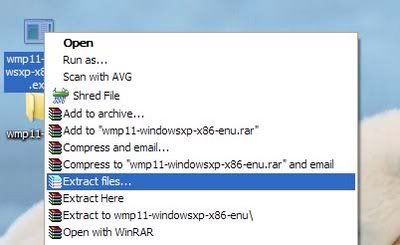 just right click on the exe and click extract
MAKE WINXP STARTUP/SHUTDOWN FASTER !
over the last 6 m since i started using a pc, i used to get really pissed off sitting & twidling my thumbs, till my WinXP/SP1, started/shutdown.
So i looked around to see how i could reduce these times. here are my observations. if you can add to them or correct me, pls do so.
1. restrict the no. of start-ups. i have only igfxTray.exe. hkcmd.exe, ctfmon.exe as my start-ups; and my pc works just fine.
2. disable services which one may not require. if one does not connect to the internet or if your pc is a stand-alone one, there may b sevral services which u can disable or switch over to manual mode. auto-starting of services and closing down of services takes time & resources. these can be saved.
3. enable boot defragmentation, so that files used during start-up are clubbed together.
4. reducing visual effects (winxp eye candy) can also help save it.
5. disable : "clear page file on shutdown" option. cleaning the page-file on every shut down means overwriting the data by zeros, and it takes time.
6. fine tune your registry regularly.
there are also some BIOS hacks like enabling Quick Post, disabling Boot-Up Floppy Seek, diabling Boot Daly. but i dont know how to do it and its presently out of my league. ive alraedy had to reformat by pc 6 times in the last 6 mnths since i bot it, trying these and all other types of stunts !
Generally people also recommend emptying the Prefetch directory every
week. But i believe Window uses this directory to speed up launching
applications. It analyzes the files you use during startup and the applications you launch, and it creates an index to where those files and applications are located on your hard disk. By using this index, XP can launch files and applications faster. So, by emptying the directory, are we not, most likely slowing down launching applications; even during start-up ?

Utilities like WinPatrol or Tune-Up can help you in all of the above.
Use PC Booster Trial and use it for one time and just uninstall. This will make your startup really quick...........
Microsoft Bootvis is also good
Transform a CD-ROM Drive into a Car CD Player!
To be used as CD player, the CD-ROM drive doesn't need to be connected to the computer. This way, it is possible to easily transform a CD-ROM drive into a Car CD player. Sounds crazy? Not so. With this tutorial you will be able to have a CD player in your car without spending almost anything.
The CD-ROM drive to be use may be of any type, from the first models ("1x") until the most modern ones ("60x"). The only prerequisite is that the drive needs to have is an earphone plug and volume control. And practically all CD-ROM drives have that.
There are two great advantages in transforming a CD-ROM drive into a Car CD player. First, who will want to break your car window to take CD-ROM drive? And, secondly, since any type of CD-ROM drive can be used, you may take an old drive that is just dusting away in your house (for instance, a 2x drive from an old 386 computer), which brings the cost down to almost nothing.
To install a CD-ROM drive in the car, you will need a female power plug, to be used to fit into CD-ROM drive power plug (that plug can be cut from an old power supply) and a voltage regulating integrated circuit called 7805, that may be easily found at electronic parts stores. You will also have to buy a heat dissipator for the 7805 (sold at the same store).
The car battery is a 12 V one, but the CD-ROM drive needs two voltages to work: 12 V and 5 V. The 7805 circuit is able to convert a 12 V voltage into 5 V (its pin 1 is for the input, its pin 2 is the grounding, and its pin 3 is the 5 V exit). Figure 1 shows the plan for the connection. The grounding pin should be connected to the wires of the plug grounding and the negative pole of the car battery, what is done by simply connecting that pin to the metallic body of the car.
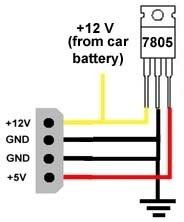 Figure 1: CD-ROM adaptor schematics.
All you have to do is to make the connections shown in the above schematics (don't forget to isolate all connections with insulating tape) and you are set: you will have a CD-ROM drive working as CD player in your car.
The audio output will be made using the earphone plug. To listen to a CD, you will have to use earphones. To have the sound come through the speakers of the car, you will have to buy an amplifier with RCA inputs and a stereo P2 (mini jack) x stereo RCA cable (the same type of cable used to connect Discman units to amplifiers). The stereo P2 plug (also known as mini jack), which is the one used for the earphones, should be fit at the earphone output of the CD-ROM drive, while the RCA plugs should be fit at the input of the amplifier. The volume control will be made using the volume control in the CD-ROM drive.
A last warning: in most CD-ROM drives, the reproduction button (play) and the advance button (skip) are on the same key. In other words, to skip a track, all you have to do is to press the play button.
Frequently Asked Questions
Can the CD-ROM drive in use as a car CD player reproduce MP3 files?
No. If not connected to a computer, the CD-ROM drive will only work to play audio CDs. Music CDs in the MP3 format are recorded in the CD-ROM format. To read it, the unit forcibly needs to be connected to a computer. MP3 songs are not played by the CD-ROM drive, but rather by the sound card of the computer, and the machine processor is responsible for transforming the MP3 format into an audio format. Car CD players that play MP3 have a dedicated processor capable of reading the CD-ROM format and of converting MP3 files into audio ones. Since the common CD-ROM drive doesn't have such processor, it can not play MP3 files.
Can the same adaptation be made so CDs may be played in a domestic sound system?
Yes. To do so, the sound system must have an auxiliary input channel. However, to prevent the sound from getting distorted, you will have to use the audio output at the back of the CD-ROM drive and nor the earphone output, as mentioned last week. To do this, you will have to take the audio output cable from the CD-ROM drive and solder two RCA plugs - a black or white one (left channel) and a red or yellow one (right channel) – at the end that should be connected to the sound card of the computer. If you don't know how to do that, contact an electronics technician. To feed the CD-ROM drive you may use a power source from an old PC. One important detail: AT power sources have an on-off switch, but the ATX ones don't. If you will use an ATX power source, you will have to make a pin-14 connection (green wire), from the main plug of the source to any black wire to turn it on.
Won't the CD oscillate too much?
That will depend on the unit used (its manufacturer and model). Of course you cannot expect a CD-ROM drive to have the same stability of a car CD player. Remember that our tip is to assemble a car CD player spending nothing (or almost nothing). If you used our tip it is because you are possibly not willing to buy a car CD player.
Why should the connection between the CD-ROM unit and the amplifier be made using the ear phone output and not the one at the back of the unit?
That is because car amplifiers don't usually have volume control. If you use the output at the back of the CD-ROM drive – which doesn't have volume control either – the sound from the amplifier will always be at its loudest. We believe that this is not convenient. If you should use the output at the back of the CD-ROM drive only if you are to connect it to a pre-amplifier, equalizer, mixer, or home sound system, since they have volume control.
Source: http://www.hardwaresecrets.com/article/71

